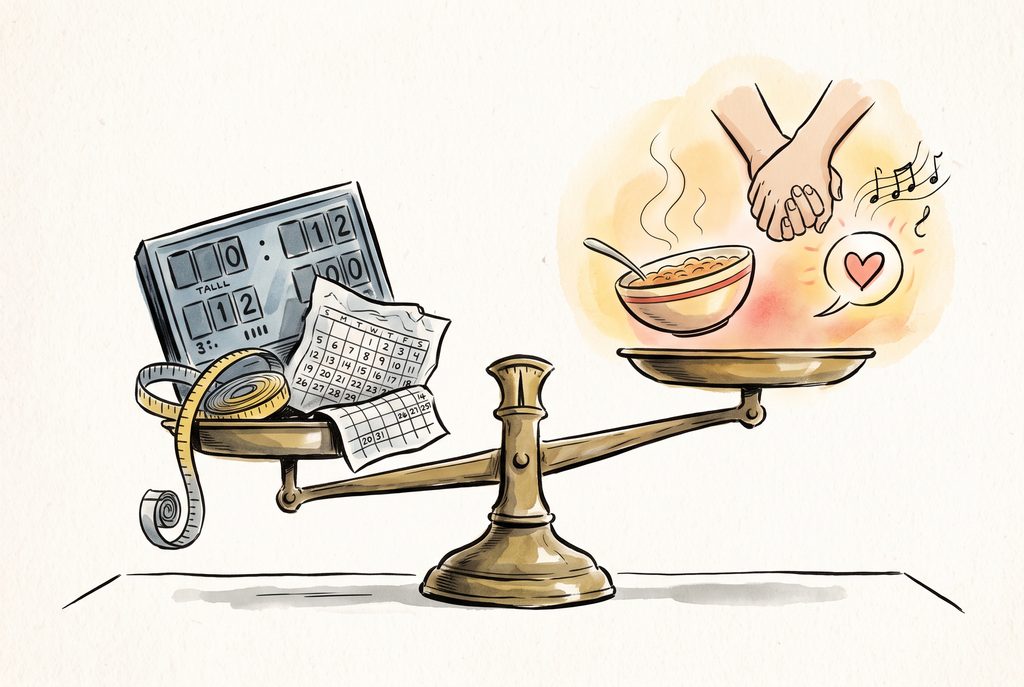
This morning a strange question popped into my head: what would life look like if humans had never invented numbers?
It felt deep for about ten minutes. Then I realised it doesn’t really work. Counting is ancient. People were scratching tally marks on bones to keep track of the seasons and their animals long before anyone had a calendar or a bank. Without numbers there would be no trading, no fair sharing, no agreeing on who owes what. A world without them wouldn’t be a simpler version of ours. It would be a much harder one.
But the question kept bothering me, and after a while I understood why. I wasn’t really picturing a world without counting. I was picturing a world where we don’t turn every number into a judgment. That’s a smaller question, but a better one.
Think about food. These days many of us eat by the numbers: calories on the label, grams in an app, a daily limit we’re not supposed to cross. Knowing what is in your meal can be useful, and I’m not against that. What bothers me is the moment a number stops informing us and starts grading us. You can finish a good meal feeling perfectly fine and still feel guilty because a screen says you went over. Our bodies give us their own signals about hunger and fullness, and somewhere along the way many of us learned to trust the app more than ourselves.
Age is the example I keep coming back to. We count the years since birth, and from that one number we build a whole set of expectations. There is an age by which you should have finished studying, an age for getting married, and an age after which changing direction is seen as a crisis instead of a choice. None of that is in the number itself. We put it there.
Look at what happens when two people fall in love. Before anyone asks whether they are kind to each other, someone works out the gap between their birth years and passes judgment on it. A real bond gets shrunk down to a subtraction. And we all know someone who has more energy at fifty than most people have at twenty-five, at least until they say their age out loud, and then everyone quietly labels them differently. If we had no way of counting years, we would be a bit like immortals. People would see us for how we are in the room, not for what is written on a document. We would still grow up, change and grow old. We just wouldn’t have a number to judge each other by.
Of course, age is not always meaningless. Fertility really does change over time, and that is useful to know, especially for women making decisions about their future. But notice how quickly that useful fact turns into pressure. A piece of health information becomes a deadline, and a deadline becomes a judgment about how a woman is living her life. The number was only ever a rough guide. A doctor looking at one person’s actual health can tell her far more than her birthday can.
And yet, I work in engineering, where numbers form the base, so I know what numbers are for.
The building you are sitting in is standing because someone worked out how much weight it could carry and what an earthquake would do to it. If they had got it wrong, people would be hurt, and good intentions alone don’t hold up a roof. Medicine is the same. Kindness at a bedside matters enormously, but it alone doesn’t cure anything. A slightly little medicine does nothing, and a little too much can be poison. Even the food in your kitchen reached you because people kept track of how much was grown, stored and delivered. Without that, one bad harvest could leave a whole town hungry.
So both sides are true, and the usual advice of “use numbers for bridges, not for love” is too comfortable. It makes the choice sound free, and it isn’t.
Here is the honest version: giving up numbers is not free. If you stop weighing yourself, you might end up a little heavier. If you stop tracking your work, you might get less done. If you stop thinking about people’s ages, you may sometimes misjudge them. These are real losses, and they are easy to see because they show up as numbers, like a higher weight or a shorter list of things done. But what you gain, like enjoying your food without guilt or feeling at ease with someone, can’t be written down anywhere. So when we compare the two, the loss is always visible and the gain is always invisible. That is why numbers tend to win the argument, even when they shouldn’t.
Sometimes giving up a little of the counting is worth it. A number can tell me my weight, but it can’t tell me whether I enjoyed my dinner. I would rather be a little behind on the scoreboard and really enjoy my life than be ahead on paper and feel nothing. Most of what makes life good was never on the scoreboard anyway.